文章 · 逐段对译 · 2026-11-10

Atlas 装上轮子

Bridging Classical Motor Controls and Whole-Body RL · Boston Dynamics 官方博客

材料信息 · 来源 / 日期 / 转录状态(点开)

材料

Boston Dynamics 官方博客 · Atlas On a Roll

副标题

Bridging Classical Motor Controls and Whole-Body RL

作者

Xiaoyu (Andy) Wu,Atlas 团队控制工程师

来源链接

https://bostondynamics.com/blog/atlas-on-a-roll/

抓取日期

2026-11-10

性质

网页正文逐段抓取,英文原文一字不动

发布日期

官方页面未显示;第三方一致口径为 2026-11-09

备注

原文中 “classical”‘ 的引号写法、段尾空格、图片说明保留原样,未校对修改

对齐方式:原文与译文按 ¶ 编号逐段对齐,共 19 个对照段,未做任何猜测配对。
排版显示字号

Atlas On a Roll

Bridging Classical Motor Controls and Whole-Body RL

Atlas 装上轮子

在经典电机控制与全身强化学习之间架桥

篇首题注
EN · 原文

This article was written by Xiaoyu (Andy) Wu, a Controls Engineer on the Atlas team. He has more than a decade of experience, at Boston Dynamics and before, controlling electric motors and the power electronics that drive them.

中文 · 译文

本文由 Xiaoyu (Andy) Wu 撰写,他是 Atlas 团队的控制工程师。在波士顿动力及此前的工作里,他有十多年控制电动机与驱动它们的功率电子器件的经验。

¶1
EN · 原文

What happens when you put wheels on a humanoid and let a learned controller drive it? We swapped the feet on our Atlas® robot to find out; it let us push our actuators, and our models of them, hard.

中文 · 译文

如果给人形机器人装上轮子,再让一个学出来的控制器去开它,会发生什么?我们把 Atlas® 机器人 的脚换掉,就是为了弄明白这件事;这样能把我们的执行器,以及我们为执行器建的模型,逼到极限。

¶2
EN · 原文

A wheeled Atlas isn’t a product. It’s a research testbed. From years of data on customer experiences with Spot and Stretch, we know that robots in the real world often experience challenges we can’t fully recreate in the lab; we need to understand how our robots will react to extreme circumstances and to ensure reliability at the limits. As Atlas’ other athletic feats, we have to find ways to push the limits. The goal of this project was to see how faithfully a learned whole-body controller can work with real actuators, especially when they’re running at the edge of their performance envelopes.

中文 · 译文

装轮子的 Atlas 不是一个产品,它是一台研究试验台。从 Spot 和 Stretch 多年积累的 客户使用数据 里我们知道:真实世界里的机器人常会遇到实验室无法完整复现的挑战;我们需要弄清机器人在极端工况下会怎么反应,并确保它在极限处依然可靠。和 Atlas 其它那些运动壮举 一样,我们得想办法去推这个极限。这个项目的目标,是看看一个学出来的全身控制器与真实执行器配合时能有多忠实——尤其是当执行器正跑在性能包络边缘的时候。

Why Wheels?

为什么用轮子?

¶3
EN · 原文

We wanted a scenario where the motors had to deliver high torque and high speed continuously, carrying real load the whole time. Driving on wheels fits that perfectly: every launch, turn, and stop pushes the motors across their full torque-speed range.

中文 · 译文

我们想要这样一个场景:电机必须持续地同时输出高扭矩和高转速,并且全程带着真实负载。用轮子跑恰好完美符合:每一次起步、转向、刹停,都会把电机扫过它完整的扭矩-转速范围。

¶4
EN · 原文

The conversion itself turned out to be wonderfully simple. A single custom adapter mounts an off-the-shelf scooter rim onto our existing ankle actuator, and that’s the only new part in the whole build. Because Atlas was designed from the start to be produced at high volume and to be easy to service, the retrofit was about as involved as swapping a wheel on a bicycle.

中文 · 译文

改装本身简单得出奇。只用一个定制适配器,把现成的滑板车轮圈装到我们原有的脚踝执行器上——这就是整台改装里唯一的新零件。因为 Atlas 从一开始就是按「可大批量生产、易维护」设计的,这次改造的工作量差不多等于给自行车换个轮子。

¶5
EN · 原文

The software side was just as straightforward. Each wheel is simply modeled as an “ankle” that can spin continuously, so all I had to do was take the baseline robot model and swap the feet out for wheels.

中文 · 译文

软件那侧同样直截了当。每个轮子只是被建模成一个「能连续旋转的脚踝」,所以我要做的,就是拿基线机器人模型,把脚换成轮子。

¶6
EN · 原文

I’m still amazed at just how easy the whole process was.

中文 · 译文

整个过程之轻松,到现在还让我惊讶。

¶7
EN · 原文

Coming from a more “classical”‘ motor controls background, this was my first real dive into reinforcement learning. It was a great opportunity to learn RL from people who do it every day. Beyond pushing the hardware to its limits, I wanted a control response that felt intuitive, responsive, and fun to drive.

中文 · 译文

我出身更偏「经典」电机控制,这是第一次真正扎进 强化学习。这是个向天天做 RL 的人学习的绝佳机会。除了把硬件逼到极限,我还想要一种直觉、跟手、开起来有意思的操控响应。

Connecting the Layers

把层与层接起来

¶8
EN · 原文

On a robot like Atlas, actuator design, low-level motor control, and whole-body RL each have specialists who know their own layer deeply. This project let me work on the boundaries between those layers. If the simulation used for training assumes the motors are over-idealized, the policy can end up learning things the real hardware can’t actually do. If the simulated motors behave the way the real ones do, the policy learns moves that the robot can carry out for real, with confidence.
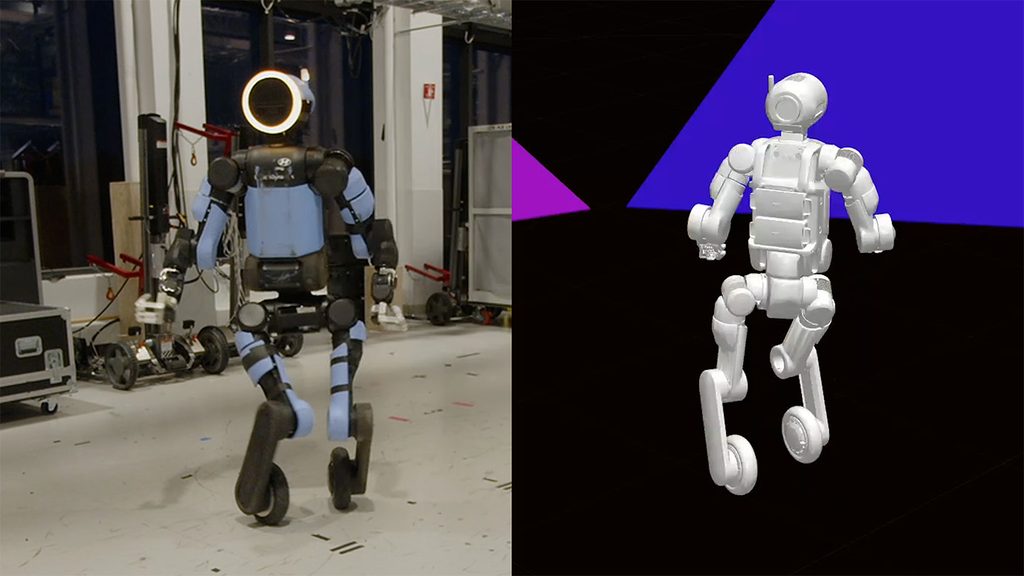
中文 · 译文

在 Atlas 这样的机器人上,执行器设计、底层电机控制、全身强化学习,各有各自钻研得很深的专家。这个项目让我得以在这些层之间的边界上工作。如果训练用的仿真把电机假定得过于理想,策略最后可能学到真硬件根本做不到的东西。如果仿真里的电机表现得和真电机一样,策略学到的动作就是机器人真能做出来的,而且有把握。

A real Atlas robot mirrors a simulated robot learning the same behavior

Closing the Sim-to-Real Gap

弥合仿真到真机的差距

¶9
EN · 原文

A quick primer: Reinforcement learning works by running millions of simulations of the robot before it ever runs on the hardware. But for the training to be useful, the simulated robot needs to mirror the real-life hardware. Can we make the simulated motor behave enough like the real world one so that the simulation-trained policy transfers over to the physical robot? Closing that simulation-to-hardware gap, also called the sim2real gap, is the real challenge, and it’s why this project was an important learning platform.

中文 · 译文

先补个基础:强化学习的做法,是在机器人还没上真机之前,先跑上百万次仿真。但训练要有用,仿真里的机器人得映照出真实硬件。我们能让仿真电机表现得足够像现实里那台,好让仿真里训出来的策略迁移到物理机器人上吗?弥合这道仿真与硬件之间的差距(也叫 sim2real gap),才是真正的挑战,也正是这个项目成为重要学习平台的原因。

¶10
EN · 原文

A good share of that work was unglamorous but important: checking that the low-level control parameters matched across every software setup, running characterization experiments, and tuning the simulated motor model to match what we measured on the robot. Just as important was knowing which approximations were safe to make and which ones the policy would learn to exploit. The goal was for the policy to train against the same “plant” it would meet on the hardware.

中文 · 译文

这份工作里相当一部分不光鲜但很重要:核对底层控制参数在每一套软件配置里都一致、跑特性标定实验、把仿真电机模型调到与真机实测吻合。同样重要的是判断哪些近似是安全的、哪些会被策略学会钻空子。目标是让策略训练时面对的「被控对象」,和它在硬件上遇到的是同一个。

¶11
EN · 原文

Transitioning into RL meant adapting established policy frameworks rather than starting from scratch. A few targeted changes to the reward composition, the range of commands the policy trains on, and how it holds its posture were enough for smooth rolling to emerge on its own, while the robot stayed stable and easy to drive.

中文 · 译文

转入 RL 意味着改造现成的策略框架,而不是从零开始。只对三处做了有针对性的改动——奖励组成、策略训练时指令的范围、以及它保持姿态的方式——平滑的滚动就自己涌现出来了,同时机器人保持稳定、好开。

¶12
EN · 原文

Working across these layers, I found that the robot’s limits usually lived in the space between them, in how the motors, the low-level control, and the training all play off one another. Getting to see that interplay up close, and exploring this rich design space, was my favorite part of the project.

中文 · 译文

跨这些层工作之后,我发现机器人的极限通常住在层与层之间:在电机、底层控制、训练三者如何互相影响里。能近距离看到这种相互作用、探索这块丰富的设计空间,是这个项目里我最喜欢的部分。

Behind the Moves

动作背后

¶13
EN · 原文

Some of the moves came from a library of human motion capture data. I deliberately looked for clips with a lot of foot sliding, since that seemed like exactly where wheels would make things interesting. And it was! Take the side dashes: where a person would slide their feet, the policy learned to steer the wheels and roll through it.

中文 · 译文

有些动作来自一个人类动捕数据资料库。我专门挑了脚打滑多的片段,因为那看起来正是轮子会让事情变有意思的地方。确实如此!拿侧向冲刺来说:人会滑脚的地方,策略学会了转向轮子、直接滚过去。

¶14
EN · 原文

The 360-degree jump was actually low-risk, despite looking like a high-energy feat. It’s a trajectory-tracking policy that follows a recording of a person doing the jump, and it worked on the first try. What was interesting was how differently it used traction compared with Atlas on feet. During the “windup” right before the jump, for example, the lower body quickly rolled into place to get ready for the upward push.

中文 · 译文

360° 转体跳看着像高能量动作,其实风险很低。它是一个轨迹跟踪策略,跟着一段人做这个跳的记录走,而且第一次就成功了。有意思的是它使用抓地力的方式,和有脚的 Atlas 完全不同。比如起跳前「蓄势」那一下,下半身会快速滚到位,为向上的蹬发力做准备。

¶15
EN · 原文

It was fascinating to see these little tricks emerge on their own. Give the policy wheels, and it figures out how to use them.

中文 · 译文

看着这些小技巧自己涌现出来,很迷人。给策略装上轮子,它自己就琢磨出该怎么用。

What Comes Next

接下来

¶16
EN · 原文

Looking back, the best part of this project for me was seeing how much understanding the motors can speed up RL policy design. Building a testbed this fun to drive showed that accurate motor models and high-level learning work best together, and that each one makes the other better.

中文 · 译文

回头看,这个项目对我来说最棒的一点,是看到「懂电机」能把 RL 策略设计加速多少。造出这么一台开起来有意思的试验台,说明精确的电机模型与高层学习最好是搭在一起干的,而且彼此会让对方更好。

¶17
EN · 原文

These insights are already being adapted back to our standard configuration. By maintaining tight integration between actuator dynamics and whole-body RL, we continue to push hardware limits, enhance policy robustness against failure modes, and expand the capability envelope of Atlas.

中文 · 译文

这些洞见已经在回流到我们的标准配置上。通过维持执行器动力学与全身 RL 之间的紧密整合,我们继续推高硬件极限、增强策略面对失效模式的鲁棒性,并扩展 Atlas 的能力包络。

篇尾致谢
EN · 原文

Before Atlas rolled across a real floor, it rolled across millions of simulated ones. Thanks to everyone who made this project possible: to Josh Geating for the wheel adapter; to Robin Deits, Shane Rozen-Levy, and Roberto Shu for the RL stack this work was built on; to our technicians, Mark Loughlin and Peter Jardin, for bolting wheels onto Atlas; and to Yuval Tassa and the MuJoCo team at Google DeepMind for the open-sourced physics engine.

中文 · 译文

在 Atlas 滚过真实地板之前,它先滚过了上百万块仿真地板。感谢让这个项目成真的所有人:感谢 Josh Geating 做了轮子适配器;感谢 Robin Deits、Shane Rozen-Levy、Roberto Shu,这套工作建立在他们做的 RL 栈之上;感谢技师 Mark Loughlin 和 Peter Jardin 把轮子拧到 Atlas 上;也感谢 Google DeepMind 的 Yuval Tassa 与 MuJoCo 团队提供了开源物理引擎。

项 值
对应原文 ../sources/2026-11-10-atlas-on-a-roll-source.md
对应译文 2026-11-10-atlas-on-a-roll-zh.md
单词 / 生句表 2026-11-10-atlas-on-a-roll-words.md
配套图解页 C:\Users\zkhap\WorkBuddy\2026-11-05-16-42-38\atlas-on-a-roll.html(首轮)、atlas-followup.html(本轮追问)
约定 资料相关问答一律入库:提问原话 + 回答逐条编号追加,不覆盖、不删改(侃姐 2026-11-09 强调)

#1 · 2026-11-10(首轮)

提问原话:

Atlas team,你来帮我介绍一下波士顿机器人里面的 Atlas 团队。他们做了一个轮式的产品,把 motor 和人形结合在一起,好像还挺有意思的,https://bostondynamics.com/blog/atlas-on-a-roll/

回答要点:

  1. 官方原文第一句就否掉"产品":"A wheeled Atlas isn't a product. It's a research testbed." 没有型号、不卖、不开产品线,结论已回流到标准双足 Atlas。
  2. "把 motor 和人形结合"是错位:2024 年后的 Atlas 本来就是全电驱、全身旋转执行器(量产版 56 自由度),不存在"把电机装进人形"这一步。这次只把两只脚换成现成滑板车轮圈,用唯一一个定制适配器装在原有脚踝执行器上;软件里把轮子建模成"能无限旋转的脚踝"。副标题的 motor 指「经典电机控制」这一层,要桥接的是它和「全身 RL」之间的缝。
  3. 项目主语不是轮子,是执行器和它的仿真模型。轮子是"加载机":走路只在短暂瞬间用力,轮子每次起步/转向/刹停把电机扫过整个扭矩-转速范围,全程带真实负载。测的是电机跑到包络边缘时,仿真训出来的控制器还忠不忠实。
  4. 团队:署名作者 Xiaoyu (Andy) Wu(Atlas 控制工程师,十多年电机与功率电子背景,首次真正做 RL);致谢 Josh Geating(适配器)、Robin Deits / Shane Rozen-Levy / Roberto Shu(RL 栈)、技师 Mark Loughlin / Peter Jardin、Google DeepMind 的 Yuval Tassa 与 MuJoCo 团队。仿真引擎是外部的,电机模型是自己的——资产边界在这句里。上层:Alberto Rodriguez 是 Atlas Director of Robot Behavior,Zack Jackowski 是 Chief Product & Technology Officer。
  5. 官方警告原文:"If the simulation used for training assumes the motors are over-idealized, the policy can end up learning things the real hardware can't actually do." 那些"不光鲜但重要"的活是逐套核对底层控制参数、真机特性实验、把实测曲线调回仿真、判断哪些近似会被策略钻空子。仿真不是越多越好,是越像越好。
  6. 瓶颈不在任何单层:"the robot's limits usually lived in the space between them"。这补上了 11-06 频率分层表没讲完的半截——那张表答"谁管哪层",这篇答"层与层之间谁负责对齐"。
  7. 轮式确实是真产品路线,只是 BD 不走:Hexagon AEON、Apptronik Apollo 2 把轮子当产品卖;Agility 的 Hurst 说 Digit 大概不加轮。判断(非官方):BD 不卖轮式,因为双足动态全身控制是它最值钱的资产,换轮子等于抹掉最难的问题。
  8. 接回 11-05 学习地图:「做很多虚拟环境让它在里面训练」的工业界答案是——仿真量不是关键,模型与真机对齐才是。与 11-07「数据是模型的副产品」合看,闭环里最贵的既不是数据也不是算力,是模型与真机的对齐,正对 foundation 层的「验证资产 / 数据治理」。
  9. 第三方报道 Hyundai Mobis 拿下 Atlas 执行器订单、2026-11 做原型、2028 供货。换了执行器特性,这套花力气标定的电机模型就得重做——验证资产绑在硬件版本上,不是一次建好永久复用(第三方 + 推论,已标)。

#2 · 2026-11-10(追问)

提问原话:

2024 年后的 Atlas 本来就是全电驱、全身旋转执行器?这句话怎么理解啊?

回答要点:那句把 3 个概念压成一行,拆开是:① 执行器 actuator = 每个关节里"让轴转起来"的那套东西(电机 + 减速器 + 驱动器 + 位置传感器),产线上对应伺服轴;占整机 BOM 约 47–51%(行业分析口径)。② 全电驱 = 不用液压油:2024-04-17 前老 Atlas 靠泵把高压油打进 28 个液压缸,力气大但吵、重、漏油、维护重、近人危险;改全电的官方理由是降复杂度/更安静/能效好,真实目标是可部署、可维护、可信任。③ 旋转执行器 = 输出"转"而非"推"(对比直线执行器/电动推杆);Atlas 很多关节能连续 360° 转,腰髋头不受人体角度限制,能上半身原地拧过去够到背后,省节拍。④ 自由度 DoF = 能独立下指令的"轴"有几根:量产 Atlas 56、老液压 28、G1 基础 23。数字大只是旋钮多,不是更聪明。


#3 · 2026-11-10(追问)

提问原话:

那它跟 Figure 出的 Figure 3,或者是宇树科技的 G1,这些有什么区别呢?

回答要点:三台现在全是电驱,硬件路线没有"谁更先进"的分水岭,差别在卖给谁、卖什么、闭环归谁。Atlas(BD):1.9m/90kg、56 DoF、30kg 持续负载、约 4h、自换电池、不零售不报价,2026 产能全给 Hyundai + Google DeepMind,卖工业装备 + Orbit 车队软件,2028 才进现代工厂。Figure 03:约 1.73m/61kg、20kg、5h、脚底无线充电,约 25 个电动执行器,自家做执行器/BotQ 工厂/Helix 全栈(S0 全身控制、S1 视觉动作、S2 语义),目标家庭通用,Helix 02 于 2026-01-27、2.5 于 2026-09-17(30 个未见家庭三项家务全任务约 56%,公司自评)。Unitree G1:1.32m/35kg、23 DoF(EDU 23–43)、单臂 2–3kg、约 2h、$13.5K 起,低惯量内转子 PMSM,支持 SDK/ROS2/二次开发,卖可买可拆的开发平台。一个巧合:三家最底层全身控制现在都是 RL 训的(Figure S0 称替换 109,504 行 C++,用 1000+ 小时人体动作 + 20 万并行仿真环境)。


#4 · 2026-11-10(追问)

提问原话:

然后你说到全身强化学习,这个跟一般的强化学习有什么区别呢?

回答要点:算法没变,问题形状变了。一般 RL = 试错 + 奖励,一次只决定少数几个动作(如夹爪开合、单腿步态),奖励好写、仿真差一点真机还能凑合。全身 RL = 一次同时决定全身几十个关节各出多大力(动作空间从个位数跳到 56 维),强耦合(手往前伸重心就前移、脚必须同时补),奖励要同时摆平"别摔 + 够到 + 踩稳 + 省电 + 动作别怪",仿真电机模型差一点策略立刻学出真机做不到的动作。BD 用的还是现成策略框架,只改三处:奖励组成、训练指令范围、保持姿态的方式。用产线讲:一般 RL ≈ 优化一台设备参数;全身 RL ≈ 同时优化整条线且一台动会影响另一台,是排产级问题。接回 11-06 分层表:RL 策略是中间层,输出目标姿态/关节指令,底层仍有电机控制环,不直接给电流。补充辨析:控制更多关节 ≠ 真正的全身智能;高层给全身参考、低层照着跟只是"跟踪",策略自己发现能用肩膀顶、靠体重后仰借力才算把身体当求解资源。


#5 · 2026-11-10(追问)

提问原话:

什么叫做包络性能?包络边缘?

回答要点:电机不是"标一个功率"能概括的——低速能憋大力、转快了力气掉;短时能超常、久了一发热就降额。把转速放横轴、扭矩放纵轴,把"所有能保证做到的组合"画出来,那块区域的外框就是性能包络 performance envelope;贴着这条线跑叫包络边缘。类似设备的工艺窗口(温度×压力),窗口外不是"慢一点"而是报警/报废。曲线形状由三条限制决定:连续扭矩受发热(铜损→绕组温度)、峰值扭矩受电流上限与磁钢退磁(只能短时 10–30 秒)、高速端受母线电压与反电动势(转越快能给的电流越小)。为什么重要:区域内部模型差 10% 无所谓,一到边缘就等于"以为能做到、实际做不到";策略会钻空子,凡仿真里留了假能力,训练时一定去用(用了得分更高),真机上就崩。轮子的作用正是把电机从低速大扭矩一路扫到高速小扭矩、全程带真实负载,逼到边缘。配套可交互扭矩-转速图在 atlas-followup.html 第 04 节(教学示意曲线,非真机实测,不能用于选型)。


#6 · 2026-11-10(追问)

提问原话:

对,我又看到这个 MuJoCo,我好像哪一天问过一个问题,就是它是不是不需要 GPU?但我忘了你是怎么回答的了。

回答要点:先认:历史对话检索没翻到那次问答(返回的两条是 Seeed 机械臂选型、AI content 建库),所以不假装复述"当时答了什么",给的是 2026-11-10 重新核过的答案。分三层:① 跑单个 MuJoCo 仿真 → 不要 GPU,它是 C 写的物理引擎(算"这个关节出这个力,下一刻身体在哪"),CPU 很快,适合教学/原型/普通笔记本;② 并行几千个环境做 RL → 要,官方给 MJX(JAX)与 MuJoCo Warp 跑 GPU/TPU,CPU 版只能多进程凑,吞吐差得远;③ 训练神经网络本身 → 要,不管用哪个仿真器。准确说法是"不要求 GPU 也能跑",不等于"不需要 GPU 也能训出全身 RL 策略"。对照 Isaac Sim:照片级渲染 + GPU 并行物理,官方最低 RTX 4080 16GB 且要 RT Core(A100/H100 因无 RT Core 被排除),本机 Intel Arc 集显跑不了。MuJoCo 现由 Google DeepMind 维护、Apache 2.0 开源,而 DeepMind 同时是 Gemini Robotics 合作方、MuJoCo 提供方、首批 Atlas 接收方、前 BD CTO/研究 VP 的去向——致谢 MuJoCo 团队不是随便引外部库。


#7 · 2026-11-10(追问)

提问原话:

还有你说的这个组织怎么变,我就没看懂:谁退休了,又去了哪里?研究机构往量产公司换血,这个你仔细再讲一下?

回答要点:按时间摆开——1992 从 MIT 分出(DARPA 研究基因),2013 Google / 2017 软银 / 2021 现代 80%(约 11 亿美元估值)/ 2026-07 现代全资;2020 创始人 Marc Raibert 卸任 CEO("商业化不是我的强项,我更擅长梦想和长期研究"),后办 RAI Institute,Robert Playter 接任;2024-04 全电 Atlas,年底裁约 5%;2025-11 CTO Aaron Saunders → Google DeepMind;2026-01 研究 VP Scott Kuindersma → Google DeepMind(同月 CES 发布量产 Atlas + Gemini Robotics 合作);2026-02-27 CEO Robert Playter 卸任(在公司 30 年、当 CEO 6 年),CFO Amanda McMaster 临时接 7 个月,同期 COO Selma Svendsen、CSO Marc Theermann 也走;2026-10-07 Rohit Prasad 上任 CEO,30 多年来第一位外聘 CEO(Amazon 12 年,Alexa 做到数亿家庭、后负责 AGI 与 Nova 基础模型;此前 14 年 Raytheon BBN),官方关键词 Physical AI / productize / at scale。背景:亏损 2022 年 2551 亿韩元 → 2024 年 4405 亿韩元(Hyundai Glovis 披露,经 36氪 转述)。"换血"的准确含义:技术路线没换,评判标准换了——研究型 KPI 是"做到别人做不到的",量产型 KPI 是"稳定、低成本、可维护地天天干活并形成收入";换掉的是决定什么算成功的人。对培训的用法:这是"AI 从试点转生产时组织要怎么变"的现成案例,卡住的不是模型能不能跑通,是组织、供应链、验收口径、维护责任。推论(已标):研究能力往模型侧转移、硬件公司专注产品交付。


#8 · 2026-11-10(追问)

提问原话:

BD 不卖轮式,谁是bd?为什么?

回答要点:BD 就是 Boston Dynamics(波士顿动力)的首字母缩写,没有第二家公司;上一页直接写缩写没交代是表述问题。官方只说 "A wheeled Atlas isn't a product. It's a research testbed." 且结论回流标准双足配置,没解释商业原因。四条推论(已标):① 最值钱资产是双足动态全身控制,装轮子把平衡问题抹掉等于自废护城河;② 现代工厂是给人设计的环境(台阶、窄通道、跨越),轮式反而要改造现场;③ 2026 产能已全给 Hyundai + DeepMind、2028 才进厂,开第二条线要重做认证/供应链/备件/维护,不划算;④ 对照组事实:Hexagon AEON、Apptronik Apollo 2 把轮式当产品卖(没有"双足控制是核心资产"的包袱),Agility 的 Hurst 说 Digit 大概不加轮。收口:轮子更快更稳更省电,但把差异化也削掉了;BD 卖的恰恰是"不用轮子也能不摔"。


#9 · 2026-11-10(追问)

提问原话:

你收到那个 articles 吧?我觉得这个挺重要的。

回答要点:按 11-08 定的分卷结构新建 D:\AI content\articles\ 类(总索引里原写"待建"),本材料单独一卷 2026-11-10-atlas-on-a-roll\,内含 sources\(官方英文原文 + URL + 抓取日期)、notes\(全文译文 / 本批注 / 单词生句表 / 入库 payload)。同时更新 D:\AI content\INDEX.md:articles 行改为已建,并在跨材料关联累积区补一条。


#10 · 2026-11-10(追问)

提问原话:

再一个就是我发现里面仍然有很多英文单词,那你还是丢给外语积累助手,用 language daily 把它都放到我的生词和生句记录本里

回答要点:按 11-09 补的约定,-words.md 只是可读副本,终点是 Language Daily 的 en 库:把词条与生句转成 JSON payload(存本卷 notes\),用 D:\AI Coding\Language Daily\scripts\ingest_list.py 提交;不改去写 english-daily 的 markdown 词库、不自行扩表。已知配置坑(未改 .env):LANGUAGE_DAILY_BASE_URL 写 8091、服务实际在 8090,INGEST_OWNER_PHONE 为空;本次用临时环境变量 LANGUAGE_DAILY_BASE_URL=http://127.0.0.1:8090 + LANGUAGE_DAILY_PHONE 绕过,脚本与 .env 均未改。选词范围限定为「本轮材料真实出现过的英文」:官方原文术语 + 前八页回答里反复出现的英文词,每条带原文语境短句。结果:62 生词 + 11 生句提交,脚本返回「生词 62 · 句子 11」;只读核对数据库后确认当天实际新增 59 行生词 + 11 行生句,actuator / hydraulic / from scratch 3 条被同库去重(返回旧记录不新增行)——与 11-09 Jeff Dean 那批 82→79+3 同一机制。


跨材料关联(写在这里,同时抄一条到总索引)

  • ↔ 2026-11-07 数据飞轮:那页结论是「数据是模型的副产品,闭环完整度 = 有多少道移交点」;这篇给出另一半——闭环里最贵的既不是数据也不是算力,是模型与真机的对齐。
  • ↔ 2026-11-09 NEURA / TUM RoboGym:企业保留数据与技能控制权,卖的是训练场会员 + 工具链;与 BD 的「仿真引擎外部、电机模型自己」是同一种资产边界判断。
  • ↔ FDE 路线图 foundation 层:验证资产 / 数据治理 / 语义层。执行器换型号 → 电机模型要重标 → 验证资产绑硬件版本。
  • ↔ 2026-11-05 机器人学习地图 E0/E1:MuJoCo 可在 CPU 跑通原型,是"不花钱不装东西"那条路的落点。
项 值
对应原文 ../sources/2026-11-10-atlas-on-a-roll-source.md
对应译文 2026-11-10-atlas-on-a-roll-zh.md
整理 小 Q · 2026-11-10
触发 侃姐 2026-11-10:「我发现里面仍然有很多英文单词……用 language daily 把它都放到我的生词和生句记录本里」
终点 Language Daily en 库;本表只是可读副本。payload:-ingest-payload.json

怎么读这份表

  • 选词范围:只收本轮材料里真实出现过的英文——官方原文术语 + 前八页讲解里反复出现、读懂会卡住的词。中学词汇、只出现一次且无理解障碍的不收;不凭空扩表。
  • 定位:¶段落号 回译文找、原文语境 回 sources 找。原文句子按官方网页原样摘录,不替它修字。
  • 中文列是词义;提示列是整理者补充的用法或辨析,不是原作者定义。
  • 生句单独一节,给语法结构 + 直译/意译,与生词一样同步入库。

A. 核心技术与工程术语(30 条)

# 词 / 短语 词性 中文 原文语境 · 定位 提示
A1 actuator n. 执行器 "it let us push our actuators, and our models of them, hard" · ¶1 关节里让轴动起来的一整套:电机 + 减速器 + 驱动器 + 传感器
A2 actuator dynamics n. 执行器动力学 "tight integration between actuator dynamics and whole-body RL" · ¶17 描述执行器受力后怎么响应,是仿真模型要标定的对象
A3 ankle actuator n. 脚踝执行器 "mounts an off-the-shelf scooter rim onto our existing ankle actuator" · ¶4 这次改装没加电机,只把轮子接到原有脚踝轴上
A4 custom adapter n. 定制适配器 "A single custom adapter mounts an off-the-shelf scooter rim" · ¶4 全机唯一新增零件
A5 off-the-shelf adj. 现成的、货架上直接买的 "an off-the-shelf scooter rim" · ¶4 对比 custom-made(定制);工程写作高频
A6 retrofit n./v. 改装、加装 "the retrofit was about as involved as swapping a wheel on a bicycle" · ¶4 指对已成型设备做事后改造,不是重新设计
A7 baseline robot model n. 基线机器人模型 "take the baseline robot model and swap the feet out for wheels" · ¶5 作为对照起点的原始模型
A8 research testbed n. 研究试验台 "It's a research testbed." · ¶2 明确区别于 product;用来做实验,不卖
A9 learned controller / learned whole-body controller n. 学出来的(全身)控制器 "see how faithfully a learned whole-body controller can work with real actuators" · ¶2 learned 指训练所得,不是手写规则
A10 whole-body RL n. 全身强化学习 "Bridging Classical Motor Controls and Whole-Body RL"(副标题) 一次同时决定全身几十个关节;与单层/单任务 RL 相对
A11 low-level motor control n. 底层电机控制 "low-level motor control, and whole-body RL each have specialists" · ¶8 频率最高、离电机最近的一层
A12 torque-speed range n. 扭矩-转速范围 "pushes the motors across their full torque-speed range" · ¶3 横轴转速、纵轴扭矩的那张能力图
A13 performance envelope n. 性能包络 "running at the edge of their performance envelopes" · ¶2 电机所有能保证做到的工况组合的外框
A14 capability envelope n. 能力包络 "expand the capability envelope of Atlas" · ¶17 同上但指整机能力边界,不是单台电机
A15 at the edge of phr. 在……的边缘 "at the edge of their performance envelopes" · ¶2 贴着极限跑;仿真最容易在这里骗人
A16 sim2real gap n. 仿真到真机的差距 "Closing that simulation-to-hardware gap, also called the sim2real gap" · ¶9 仿真训出的策略迁移到真机时失效的那道缝
A17 simulation-trained policy n. 仿真训练出的策略 "so that the simulation-trained policy transfers over to the physical robot" · ¶9 transfer over 是固定搭配:迁移过去
A18 policy framework n. 策略框架 "adapting established policy frameworks rather than starting from scratch" · ¶11 现成 RL 训练代码骨架(如 PPO 一套)
A19 reward composition n. 奖励组成 "changes to the reward composition, the range of commands ... and how it holds its posture" · ¶11 只改三处之一;权重一歪策略就学歪
A20 characterization experiments n. 特性标定实验 "running characterization experiments" · ¶10 在真机上实测曲线,用来校准仿真模型
A21 approximation n. 近似(处理) "knowing which approximations were safe to make" · ¶10 仿真里简化掉的物理细节
A22 exploit v. 钻空子、利用漏洞 "which ones the policy would learn to exploit" · ¶10 中性技术义:策略会找到并利用模型的假能力
A23 plant n. 被控对象 "train against the same 'plant' it would meet on the hardware" · ¶10 控制论术语,不是「工厂 / 植物」
A24 over-idealized adj. 过于理想化的 "assumes the motors are over-idealized" · ¶8 全篇最关键的一个词
A25 trajectory-tracking policy n. 轨迹跟踪策略 "It's a trajectory-tracking policy that follows a recording" · ¶14 跟着录制轨迹走,所以 360° 跳风险低
A26 motion capture (data) n. 动作捕捉(数据) "a library of human motion capture data" · ¶13 简写 mocap
A27 foot sliding n. 脚打滑 "clips with a lot of foot sliding" · ¶13 作者专挑这类片段,因为那里轮子会派上用场
A28 traction n. 抓地力 "how differently it used traction compared with Atlas on feet" · ¶14 与摩擦相关但不等同
A29 robustness / failure modes n. 鲁棒性 / 失效模式 "enhance policy robustness against failure modes" · ¶17 工程验收口径的两个固定词
A30 standard configuration n. 标准配置 "adapted back to our standard configuration" · ¶17 即拆掉轮子的双足版 Atlas

B. 讲解里反复出现、读懂会卡住的词(18 条)

# 词 / 短语 词性 中文 原文语境 · 定位 提示
B1 all-electric / electric actuation adj./n. 全电驱 / 电驱动 讲解 01 节;BD 官方沿革稿 "Starting the Commercial Journey with an Electric Humanoid in 2024" 对照 hydraulic(液压)
B2 hydraulic adj. 液压的 "The Death of Hydraulics: The Atlas Transition"(行业资料) 有力、吵、重、漏油、维护重
B3 rotary actuator / linear actuator n. 旋转执行器 / 直线执行器 讲解 01 节 一个输出「转」,一个输出「推拉」
B4 degree of freedom (DoF) n. 自由度 "56 degrees of freedom"(BD 规格页转述) 能独立下指令的轴有几根
B5 continuous torque / peak torque n. 连续扭矩 / 峰值扭矩 讲解 04 节(电机 T-N 曲线通用术语) 前者受发热限制,后者只能短时冲
B6 thermal limit n. 热限制 / 温度上限 同上 铜损变成热,绕组温度有上限
B7 back-EMF n. 反电动势 同上 转越快越高,挤掉可用电流 → 高速端扭矩下降
B8 torque-speed curve n. 扭矩-转速曲线 同上 厂商给的那张能力图,包络就是它的外框
B9 MJX / MuJoCo Warp n. MuJoCo 的 GPU 并行实现 讲解 05 节 CPU 版不并行;要几千环境得上这两个
B10 RT Core n. 光线追踪核心 "Isaac Sim needs an RTX GPU with RT cores"(2026 对比资料) A100/H100 没有,所以反而不被 Isaac Sim 支持
B11 whole-body control (WBC) n. 全身控制 11-06 频率分层表 RL 训出的策略是这一层,不直接给电流
B12 action space n. 动作空间 讲解 03 节 一次要同时决定多少个量;从个位数跳到 56 维
B13 coupled / coupling adj./n. 耦合的 / 耦合 讲解 03 节 手一动重心就变,不能各管各的
B14 domain randomization n. 域随机化 11-05 学习地图 仿真里随机化物理参数,帮策略迁移到真机
B15 VLA (vision-language-action) n. 视觉-语言-动作模型 11-05 学习地图 输出动作的中间层,频率约 5–30Hz
B16 teleoperation n. 遥操作 11-05 学习地图 人手把手示范,是数据不是训练方法
B17 productize / at scale v./phr. 产品化 / 大规模地 BD 2026-10-06 CEO 任命稿 换帅稿的关键词,透露评判标准变了
B18 spin-off n. 分拆出来的公司 "an MIT spin-off"(BD 公司资料) 从高校/母机构独立出来的实体

C. 口语、习语与短语动词(14 条)

# 词 / 短语 中文 原文语境 · 定位 提示
C1 push ... hard / push the limits 把……逼到极限 / 推极限 "push our actuators, and our models of them, hard" · ¶1;¶2 "push the limits" 同一动词两种搭配,全篇主线
C2 a quick primer 先补个基础 / 快速入门说明 "A quick primer: Reinforcement learning works by..." · ¶9 作者要向非 RL 读者解释时的起手
C3 unglamorous but important 不光鲜但重要 "A good share of that work was unglamorous but important" · ¶10 工程里常见的自谦式强调
C4 from scratch 从零开始 "rather than starting from scratch" · ¶11 固定短语
C5 emerge on its own 自己涌现出来 "smooth rolling to emerge on its own" · ¶11;¶15 "emerge on their own" 不是手写规则,是训练里自己长出来的
C6 play off one another 互相影响、彼此借力 "how the motors, the low-level control, and the training all play off one another" · ¶12 全篇「层与层之间」的口语版说法
C7 live in the space between 存在于……之间的缝隙里 "the robot's limits usually lived in the space between them" · ¶12 抽象位置说法,不是真的"住在"
C8 first real dive into 第一次真正扎进 "this was my first real dive into reinforcement learning" · ¶7 dive into = 深入钻研
C9 come from a ... background 出身于……背景 "Coming from a more 'classical' motor controls background" · ¶7 自我介绍常用
C10 about as involved as 工作量差不多相当于 "about as involved as swapping a wheel on a bicycle" · ¶4 用日常动作形容简单,带点自嘲
C11 figure out 琢磨明白、想出办法 "Give the policy wheels, and it figures out how to use them." · ¶15 拟人化收尾,很口语
C12 on the first try 第一次就成功 "it worked on the first try" · ¶14 强调零调试
C13 bolt ... onto 把……用螺栓装上 "for bolting wheels onto Atlas" · 致谢 比 install 更具体、更像车间说话
C14 faithful / faithfully 忠实的 / 忠实地 "see how faithfully a learned whole-body controller can work" · ¶2 这里指仿真与真机一致,不是「忠诚」

D. 易混概念对

对 怎么分 出处
performance envelope ↔ capability envelope 前者专指电机的扭矩-转速边界;后者指整机能力边界 ¶2 / ¶17
continuous torque ↔ peak torque 能一直给 vs 只能短时冲(受热/电流限制) 讲解 04 节
simulation ↔ hardware / sim2real gap 训练在前者,验收在后者,中间那道缝才是挑战 ¶9
approximation ↔ exploit 简化是人为做的;钻空子是策略主动找到并利用它 ¶10
product ↔ research testbed 官方第一句就切开:不卖、不开产品线 ¶2
MuJoCo (CPU) ↔ MJX / MuJoCo Warp (GPU) 同一个引擎,不同执行后端;"不要 GPU"只对前者成立 讲解 05 节

E. 缩写与专名速查

缩写 全称 中文
BD Boston Dynamics 波士顿动力
RL reinforcement learning 强化学习
WBC whole-body control 全身控制
DoF degree(s) of freedom 自由度
sim2real simulation to real 仿真到真机
PPO proximal policy optimization 近端策略优化(RL 常用算法)
VLA vision-language-action (model) 视觉-语言-动作模型
MPC / PID model predictive control / proportional-integral-derivative 模型预测控制 / 比例-积分-微分控制
CTO / COO / CSO / CFO / VP chief technology/operating/strategy/financial officer / vice president 首席技术/运营/战略/财务官 / 副总裁
MuJoCo Multi-Joint dynamics with Contact 多关节接触动力学(物理引擎)
MJCF MuJoCo XML model format MuJoCo 的模型格式
T-N curve torque-speed curve 扭矩-转速曲线
PMSM permanent magnet synchronous motor 永磁同步电机(宇树 G1 关节电机)
RAI Institute Robotics and AI Institute 机器人与人工智能研究院(Marc Raibert 创办)
CES Consumer Electronics Show 国际消费电子展

F. 生句(11 条,与生词一起入库)

# 原句 语法 译文
S1 A wheeled Atlas isn't a product. It's a research testbed. 两个短句对比;wheeled 是过去分词作形容词 装轮子的 Atlas 不是一个产品,它是一台研究试验台。
S2 If the simulation used for training assumes the motors are over-idealized, the policy can end up learning things the real hardware can't actually do. If 条件从句 + 过去分词短语 used for training 作后置定语 + 省略关系代词的定语从句 (that) the real hardware can't...;end up doing 表「最终落得」 如果训练用的仿真把电机假定得过于理想,策略最后可能学到真硬件根本做不到的东西。
S3 Just as important was knowing which approximations were safe to make and which ones the policy would learn to exploit. 表语前置引起倒装(正常语序 Knowing... was just as important)+ 两个并列的宾语从句 同样重要的是判断哪些近似是安全的、哪些会被策略学会钻空子。
S4 Because Atlas was designed from the start to be produced at high volume and to be easy to service, the retrofit was about as involved as swapping a wheel on a bicycle. Because 原因从句 + 两个并列不定式被动 + as ... as 同级比较 因为 Atlas 从一开始就按可大批量生产、易维护设计,这次改装的工作量差不多等于给自行车换个轮子。
S5 A good share of that work was unglamorous but important: checking that ..., running characterization experiments, and tuning the simulated motor model to match what we measured on the robot. 冒号后三个动名词并列作同位语;match 后接 what 引导的宾语从句 这份工作里相当一部分不光鲜但很重要:核对参数、跑特性标定实验、把仿真电机模型调到与真机实测吻合。
S6 The goal was for the policy to train against the same "plant" it would meet on the hardware. for sb./sth. to do 不定式复合结构作表语;plant 后省略关系代词 目标是让策略训练时面对的「被控对象」,和它在硬件上遇到的是同一个。
S7 Working across these layers, I found that the robot's limits usually lived in the space between them, in how the motors, the low-level control, and the training all play off one another. 现在分词短语作状语 + that 宾语从句 + in how 引导的介词宾语从句具体化 "the space" 跨这些层工作之后,我发现机器人的极限通常住在层与层之间:在电机、底层控制、训练三者如何互相影响里。
S8 I deliberately looked for clips with a lot of foot sliding, since that seemed like exactly where wheels would make things interesting. since 引导原因从句 + where 引导表语从句 我专门挑了脚打滑多的片段,因为那看起来正是轮子会让事情变有意思的地方。
S9 The 360-degree jump was actually low-risk, despite looking like a high-energy feat. despite + 动名词短语作让步状语 360° 转体跳看着像高能量动作,其实风险很低。
S10 Give the policy wheels, and it figures out how to use them. 祈使句 + and + 陈述句(= 条件句「只要……就……」)+ how to 不定式作宾语 给策略装上轮子,它自己就琢磨出该怎么用。
S11 Before Atlas rolled across a real floor, it rolled across millions of simulated ones. Before 时间从句 + ones 替代前面名词避免重复;rolled 一词两用形成对照 在 Atlas 滚过真实地板之前,它先滚过了上百万块仿真地板。

入库状态:2026-11-10 用 ingest_list.py 提交 62 生词 + 11 生句,脚本返回「生词 62 · 句子 11」。只读核对数据库后确认:当天实际新增 59 行生词 + 11 行生句;actuator、hydraulic、from scratch 3 条库里已有,服务端去重后返回旧记录、不新增行。脚本里的 62 是「本次返回词条数」,不是新增行数。看板 http://127.0.0.1:8090/

Atlas On a Roll

Bridging Classical Motor Controls and Whole-Body RL

This article was written by Xiaoyu (Andy) Wu, a Controls Engineer on the Atlas team. He has more than a decade of experience, at Boston Dynamics and before, controlling electric motors and the power electronics that drive them.

What happens when you put wheels on a humanoid and let a learned controller drive it? We swapped the feet on our Atlas® robot to find out; it let us push our actuators, and our models of them, hard.

A wheeled Atlas isn’t a product. It’s a research testbed. From years of data on customer experiences with Spot and Stretch, we know that robots in the real world often experience challenges we can’t fully recreate in the lab; we need to understand how our robots will react to extreme circumstances and to ensure reliability at the limits. As Atlas’ other athletic feats, we have to find ways to push the limits. The goal of this project was to see how faithfully a learned whole-body controller can work with real actuators, especially when they’re running at the edge of their performance envelopes.

Why Wheels?

We wanted a scenario where the motors had to deliver high torque and high speed continuously, carrying real load the whole time. Driving on wheels fits that perfectly: every launch, turn, and stop pushes the motors across their full torque-speed range.

The conversion itself turned out to be wonderfully simple. A single custom adapter mounts an off-the-shelf scooter rim onto our existing ankle actuator, and that’s the only new part in the whole build. Because Atlas was designed from the start to be produced at high volume and to be easy to service, the retrofit was about as involved as swapping a wheel on a bicycle.

The software side was just as straightforward. Each wheel is simply modeled as an “ankle” that can spin continuously, so all I had to do was take the baseline robot model and swap the feet out for wheels.

I’m still amazed at just how easy the whole process was.

Coming from a more “classical”‘ motor controls background, this was my first real dive into reinforcement learning. It was a great opportunity to learn RL from people who do it every day. Beyond pushing the hardware to its limits, I wanted a control response that felt intuitive, responsive, and fun to drive.

Connecting the Layers

On a robot like Atlas, actuator design, low-level motor control, and whole-body RL each have specialists who know their own layer deeply. This project let me work on the boundaries between those layers. If the simulation used for training assumes the motors are over-idealized, the policy can end up learning things the real hardware can’t actually do. If the simulated motors behave the way the real ones do, the policy learns moves that the robot can carry out for real, with confidence.

A real Atlas robot mirrors a simulated robot learning the same behavior

Closing the Sim-to-Real Gap

A quick primer: Reinforcement learning works by running millions of simulations of the robot before it ever runs on the hardware. But for the training to be useful, the simulated robot needs to mirror the real-life hardware. Can we make the simulated motor behave enough like the real world one so that the simulation-trained policy transfers over to the physical robot? Closing that simulation-to-hardware gap, also called the sim2real gap, is the real challenge, and it’s why this project was an important learning platform.

A good share of that work was unglamorous but important: checking that the low-level control parameters matched across every software setup, running characterization experiments, and tuning the simulated motor model to match what we measured on the robot. Just as important was knowing which approximations were safe to make and which ones the policy would learn to exploit. The goal was for the policy to train against the same “plant” it would meet on the hardware.

Transitioning into RL meant adapting established policy frameworks rather than starting from scratch. A few targeted changes to the reward composition, the range of commands the policy trains on, and how it holds its posture were enough for smooth rolling to emerge on its own, while the robot stayed stable and easy to drive.

Working across these layers, I found that the robot’s limits usually lived in the space between them, in how the motors, the low-level control, and the training all play off one another. Getting to see that interplay up close, and exploring this rich design space, was my favorite part of the project.

Behind the Moves

Some of the moves came from a library of human motion capture data. I deliberately looked for clips with a lot of foot sliding, since that seemed like exactly where wheels would make things interesting. And it was! Take the side dashes: where a person would slide their feet, the policy learned to steer the wheels and roll through it.

The 360-degree jump was actually low-risk, despite looking like a high-energy feat. It’s a trajectory-tracking policy that follows a recording of a person doing the jump, and it worked on the first try. What was interesting was how differently it used traction compared with Atlas on feet. During the “windup” right before the jump, for example, the lower body quickly rolled into place to get ready for the upward push.

It was fascinating to see these little tricks emerge on their own. Give the policy wheels, and it figures out how to use them.

What Comes Next

Looking back, the best part of this project for me was seeing how much understanding the motors can speed up RL policy design. Building a testbed this fun to drive showed that accurate motor models and high-level learning work best together, and that each one makes the other better.

These insights are already being adapted back to our standard configuration. By maintaining tight integration between actuator dynamics and whole-body RL, we continue to push hardware limits, enhance policy robustness against failure modes, and expand the capability envelope of Atlas.

Before Atlas rolled across a real floor, it rolled across millions of simulated ones. Thanks to everyone who made this project possible: to Josh Geating for the wheel adapter; to Robin Deits, Shane Rozen-Levy, and Roberto Shu for the RL stack this work was built on; to our technicians, Mark Loughlin and Peter Jardin, for bolting wheels onto Atlas; and to Yuval Tassa and the MuJoCo team at Google DeepMind for the open-sourced physics engine.

项 值
对应原文 ../sources/2026-11-10-atlas-on-a-roll-source.md
原文链接 https://bostondynamics.com/blog/atlas-on-a-roll/
抓取日期 2026-11-10
整理 小 Q · 2026-11-10
性质 全文逐段对译,不做观点分析、不预置提问

译法约定:actuator 统一译「执行器」;policy 译「策略」;whole-body RL 译「全身强化学习」;plant 保留控制论术语「被控对象」;performance envelope 译「性能包络」;testbed 译「试验台」;sim2real gap 译「仿真到真机的差距」。专名(人名、MuJoCo、Spot / Stretch / Atlas)保留原文。原文引号写法异常处不改动英文,中文按文意顺。


Atlas 装上轮子

在经典电机控制与全身强化学习之间架桥

本文由 Xiaoyu (Andy) Wu 撰写,他是 Atlas 团队的控制工程师。在波士顿动力及此前的工作里,他有十多年控制电动机与驱动它们的功率电子器件的经验。

¶1 如果给人形机器人装上轮子,再让一个学出来的控制器去开它,会发生什么?我们把 Atlas® 机器人 的脚换掉,就是为了弄明白这件事;这样能把我们的执行器,以及我们为执行器建的模型,逼到极限。

¶2 装轮子的 Atlas 不是一个产品,它是一台研究试验台。从 Spot 和 Stretch 多年积累的 客户使用数据 里我们知道:真实世界里的机器人常会遇到实验室无法完整复现的挑战;我们需要弄清机器人在极端工况下会怎么反应,并确保它在极限处依然可靠。和 Atlas 其它那些运动壮举 一样,我们得想办法去推这个极限。这个项目的目标,是看看一个学出来的全身控制器与真实执行器配合时能有多忠实——尤其是当执行器正跑在性能包络边缘的时候。

为什么用轮子?

¶3 我们想要这样一个场景:电机必须持续地同时输出高扭矩和高转速,并且全程带着真实负载。用轮子跑恰好完美符合:每一次起步、转向、刹停,都会把电机扫过它完整的扭矩-转速范围。

¶4 改装本身简单得出奇。只用一个定制适配器,把现成的滑板车轮圈装到我们原有的脚踝执行器上——这就是整台改装里唯一的新零件。因为 Atlas 从一开始就是按「可大批量生产、易维护」设计的,这次改造的工作量差不多等于给自行车换个轮子。

¶5 软件那侧同样直截了当。每个轮子只是被建模成一个「能连续旋转的脚踝」,所以我要做的,就是拿基线机器人模型,把脚换成轮子。

¶6 整个过程之轻松,到现在还让我惊讶。

¶7 我出身更偏「经典」电机控制,这是第一次真正扎进 强化学习。这是个向天天做 RL 的人学习的绝佳机会。除了把硬件逼到极限,我还想要一种直觉、跟手、开起来有意思的操控响应。

把层与层接起来

¶8 在 Atlas 这样的机器人上,执行器设计、底层电机控制、全身强化学习,各有各自钻研得很深的专家。这个项目让我得以在这些层之间的边界上工作。如果训练用的仿真把电机假定得过于理想,策略最后可能学到真硬件根本做不到的东西。如果仿真里的电机表现得和真电机一样,策略学到的动作就是机器人真能做出来的,而且有把握。

一台真实 Atlas 与一台正在学同一动作的仿真机器人相互映照

弥合仿真到真机的差距

¶9 先补个基础:强化学习的做法,是在机器人还没上真机之前,先跑上百万次仿真。但训练要有用,仿真里的机器人得映照出真实硬件。我们能让仿真电机表现得足够像现实里那台,好让仿真里训出来的策略迁移到物理机器人上吗?弥合这道仿真与硬件之间的差距(也叫 sim2real gap),才是真正的挑战,也正是这个项目成为重要学习平台的原因。

¶10 这份工作里相当一部分不光鲜但很重要:核对底层控制参数在每一套软件配置里都一致、跑特性标定实验、把仿真电机模型调到与真机实测吻合。同样重要的是判断哪些近似是安全的、哪些会被策略学会钻空子。目标是让策略训练时面对的「被控对象」,和它在硬件上遇到的是同一个。

¶11 转入 RL 意味着改造现成的策略框架,而不是从零开始。只对三处做了有针对性的改动——奖励组成、策略训练时指令的范围、以及它保持姿态的方式——平滑的滚动就自己涌现出来了,同时机器人保持稳定、好开。

¶12 跨这些层工作之后,我发现机器人的极限通常住在层与层之间:在电机、底层控制、训练三者如何互相影响里。能近距离看到这种相互作用、探索这块丰富的设计空间,是这个项目里我最喜欢的部分。

动作背后

¶13 有些动作来自一个人类动捕数据资料库。我专门挑了脚打滑多的片段,因为那看起来正是轮子会让事情变有意思的地方。确实如此!拿侧向冲刺来说:人会滑脚的地方,策略学会了转向轮子、直接滚过去。

¶14 360° 转体跳看着像高能量动作,其实风险很低。它是一个轨迹跟踪策略,跟着一段人做这个跳的记录走,而且第一次就成功了。有意思的是它使用抓地力的方式,和有脚的 Atlas 完全不同。比如起跳前「蓄势」那一下,下半身会快速滚到位,为向上的蹬发力做准备。

¶15 看着这些小技巧自己涌现出来,很迷人。给策略装上轮子,它自己就琢磨出该怎么用。

接下来

¶16 回头看,这个项目对我来说最棒的一点,是看到「懂电机」能把 RL 策略设计加速多少。造出这么一台开起来有意思的试验台,说明精确的电机模型与高层学习最好是搭在一起干的,而且彼此会让对方更好。

¶17 这些洞见已经在回流到我们的标准配置上。通过维持执行器动力学与全身 RL 之间的紧密整合,我们继续推高硬件极限、增强策略面对失效模式的鲁棒性,并扩展 Atlas 的能力包络。

在 Atlas 滚过真实地板之前,它先滚过了上百万块仿真地板。感谢让这个项目成真的所有人:感谢 Josh Geating 做了轮子适配器;感谢 Robin Deits、Shane Rozen-Levy、Roberto Shu,这套工作建立在他们做的 RL 栈之上;感谢技师 Mark Loughlin 和 Peter Jardin 把轮子拧到 Atlas 上;也感谢 Google DeepMind 的 Yuval Tassa 与 MuJoCo 团队提供了开源物理引擎。


译注与存疑

  1. ¶2 原文 "As Atlas' other athletic feats, we have to find ways to push the limits" 语法不完整(缺谓语),按上下文译作「和其它运动壮举一样,我们得想办法推极限」,属补全,标 [?]。
  2. ¶7 原文引号写作 “classical”‘,疑为排版错误,中文按「经典」处理,未改英文原文。
  3. ¶8 "with confidence" 译作「而且有把握」,指对策略动作可在真机复现的信心,不是「机器人有自信」。
  4. ¶10 plant 是控制论固定术语,指被控制的那个物理系统;这里特指仿真中的电机+传动模型。若按字面「工厂 / 设备」会读反。
  5. ¶14 windup 借棒球/高尔夫「引杆蓄力」,译「蓄势」;traction 译「抓地力」,与摩擦系数相关但不等同。
  6. ¶17 capability envelope 与 ¶2 performance envelope 是同一类「包络」说法,前者指整机能力边界、后者专指电机性能边界,译文保留区别。
  7. 结尾致谢两段斜体在原文被 * 切成两段,属网页排版,中文合并为一段。
  8. 官方页面未显示发布日期;2026-11-09 为多家第三方一致口径,不是官方标注。